
Private Beta Access
Enter the password to access this page
Enter the password to access this page
AI-powered document verification and training intelligence for UK CAA and EASA approved training organisations. Stop sampling. Start systematic assurance.
Every training flight requires verification across dozens of documents. Most ATOs check samples, not everything. The result: illegal flights, audit anxiety, and constant risk.
A medium ATO has 60 trainees, 15 instructors, 8 aircraft. That's hundreds of documents, each with different expiry dates and limitations.
Easy to misread a date, forget to update a spreadsheet, or assume someone else has checked. One mistake can ground operations.
In practice, most ATOs check 10-20% of records before flights. The rest rely on trust and hope.
When the CAA asks "how do you know this person was legal to fly?", the honest answer is often "we can't prove it now."
Problems discovered too late: during an audit, or after an illegal flight has already occurred.
8-30 hours per week on document checking. Regulatory findings. Certificate suspension risk. Constant anxiety.
Different people in your organisation experience different problems. Heading AI is designed so that each role sees exactly what is relevant to them.
Significant time saving
No more manual data entry, no more spreadsheet tracking, no more trying to remember who needs chasing. Document requests sent directly to individuals and tracked to completion.
Transformative visibility
Not just compliance status, but training intelligence. Which trainees need attention. Which instructors may need a standardisation conversation. Which graduates are ready to recommend to airline partners. All surfaced automatically.
Audit prep collapses from days to minutes
Complete timestamped evidence of every verification performed, every document processed, every recommended action raised and resolved. Demonstrate continuous compliance culture, not point-in-time checking.
Independent governance view
The AM carries personal regulatory responsibility but is entirely dependent on the information they are given. Heading AI provides a high-level organisational health dashboard, trend direction, and direct escalation of critical unresolved items.
Continuous, automated assurance using artificial intelligence designed specifically for aviation.
Click any image to view full size
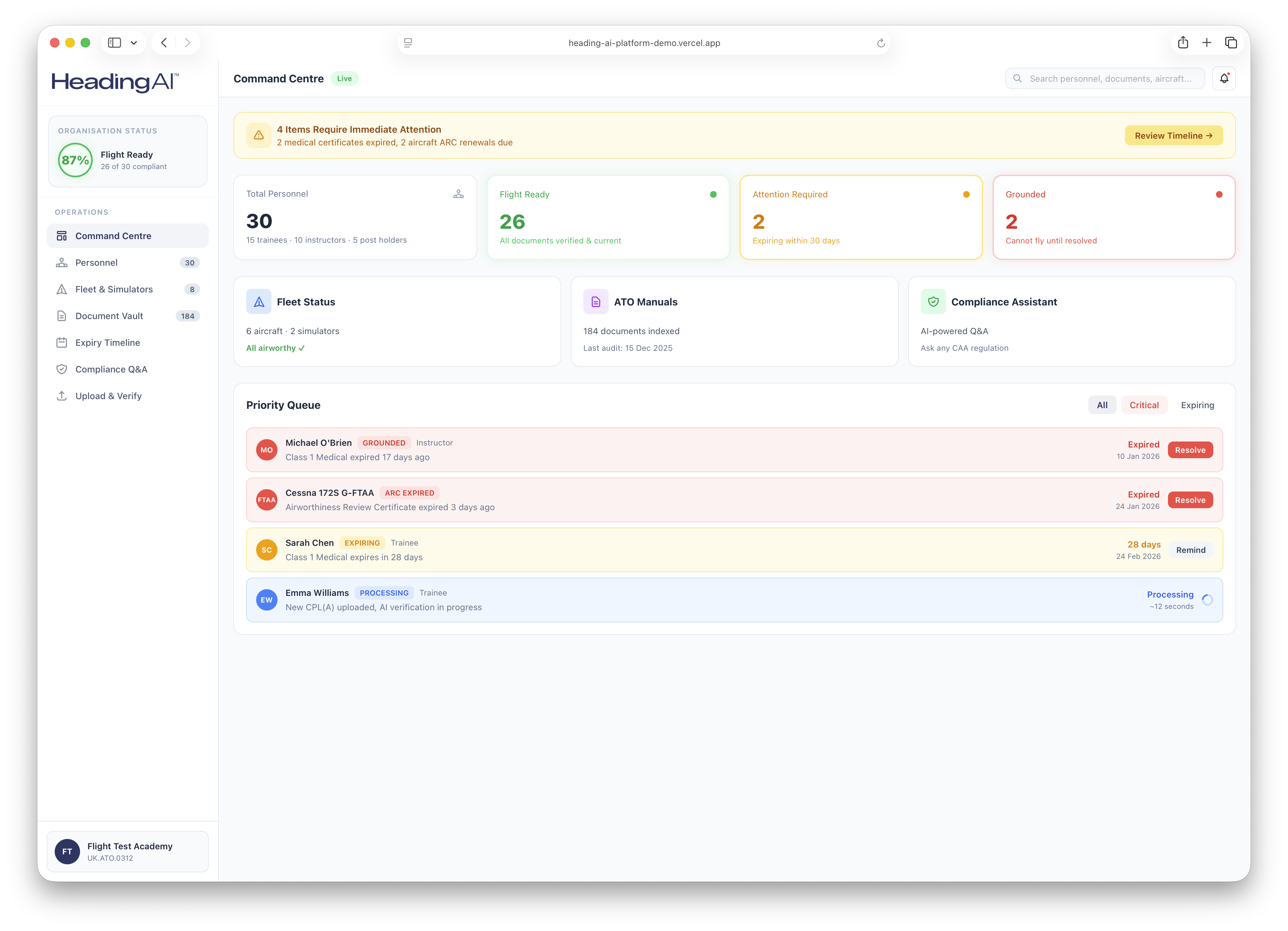
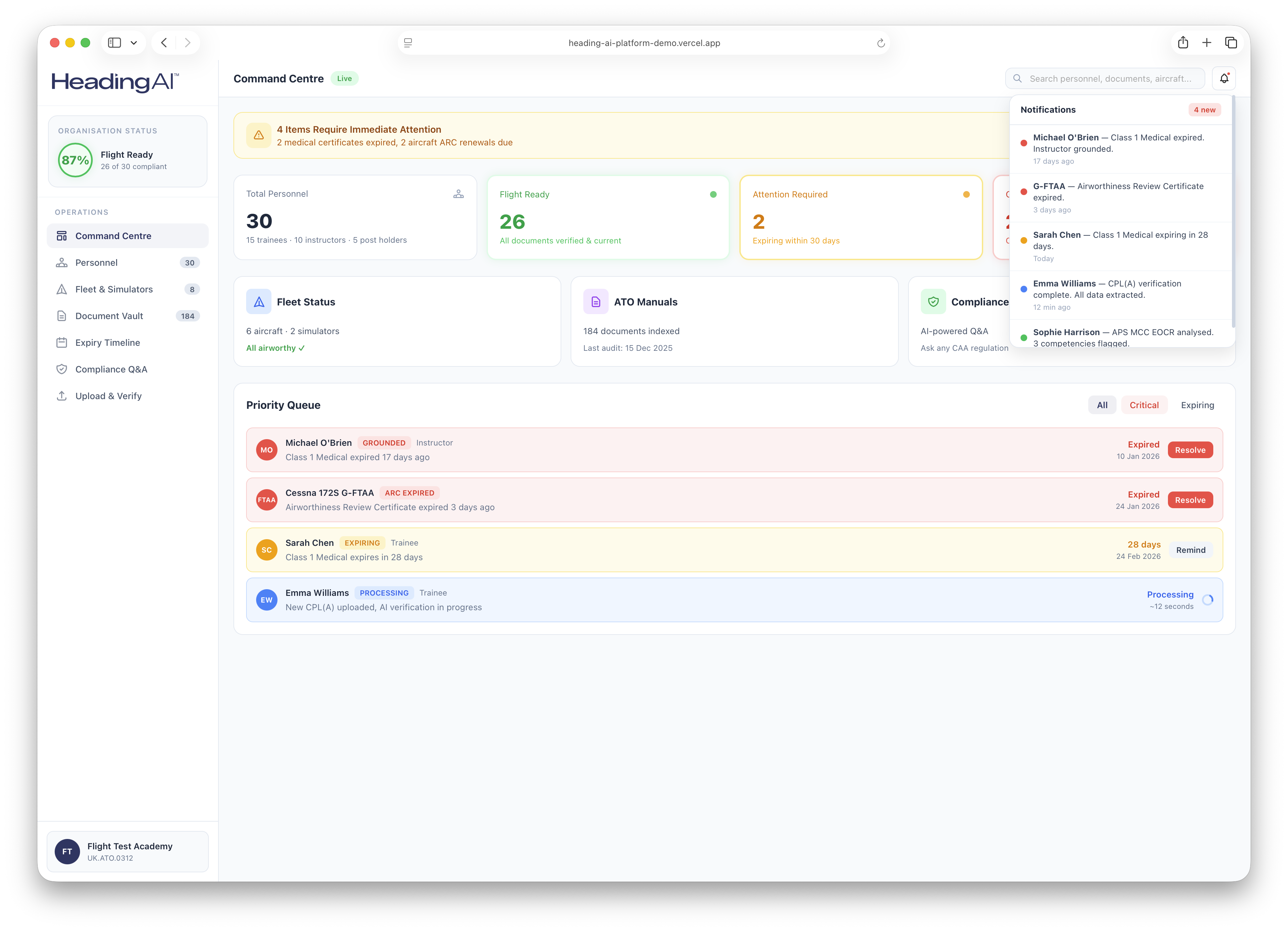
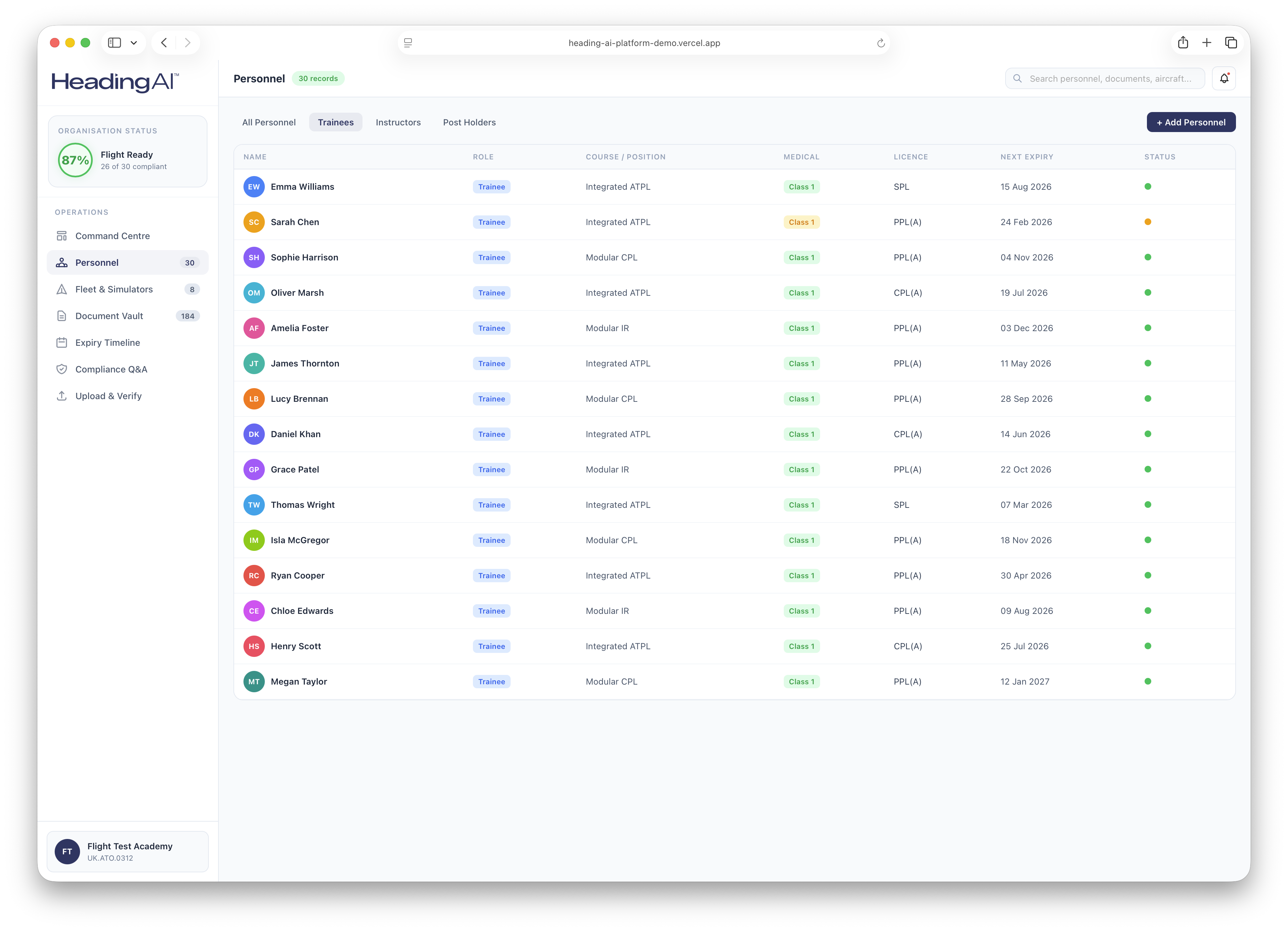
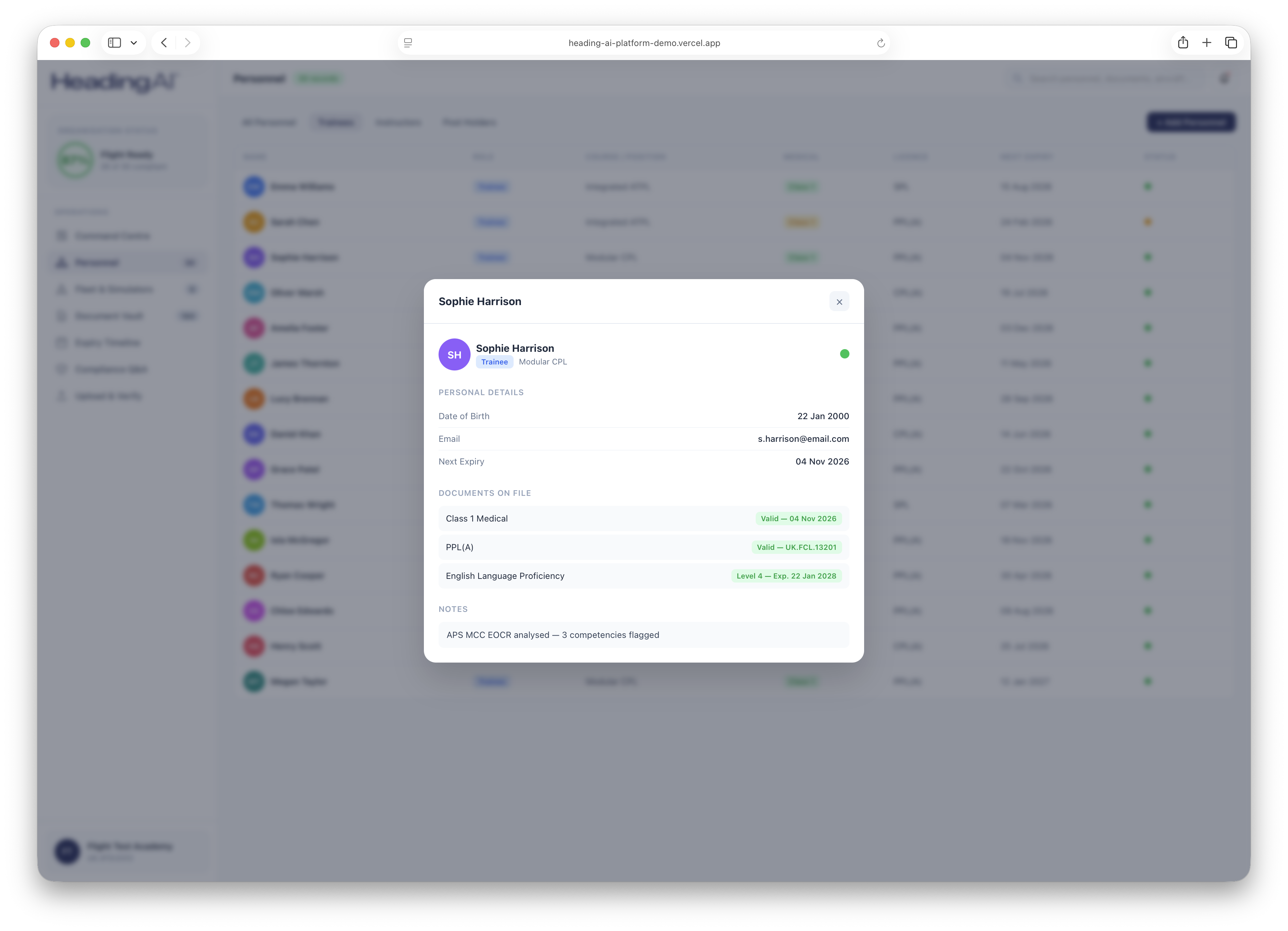
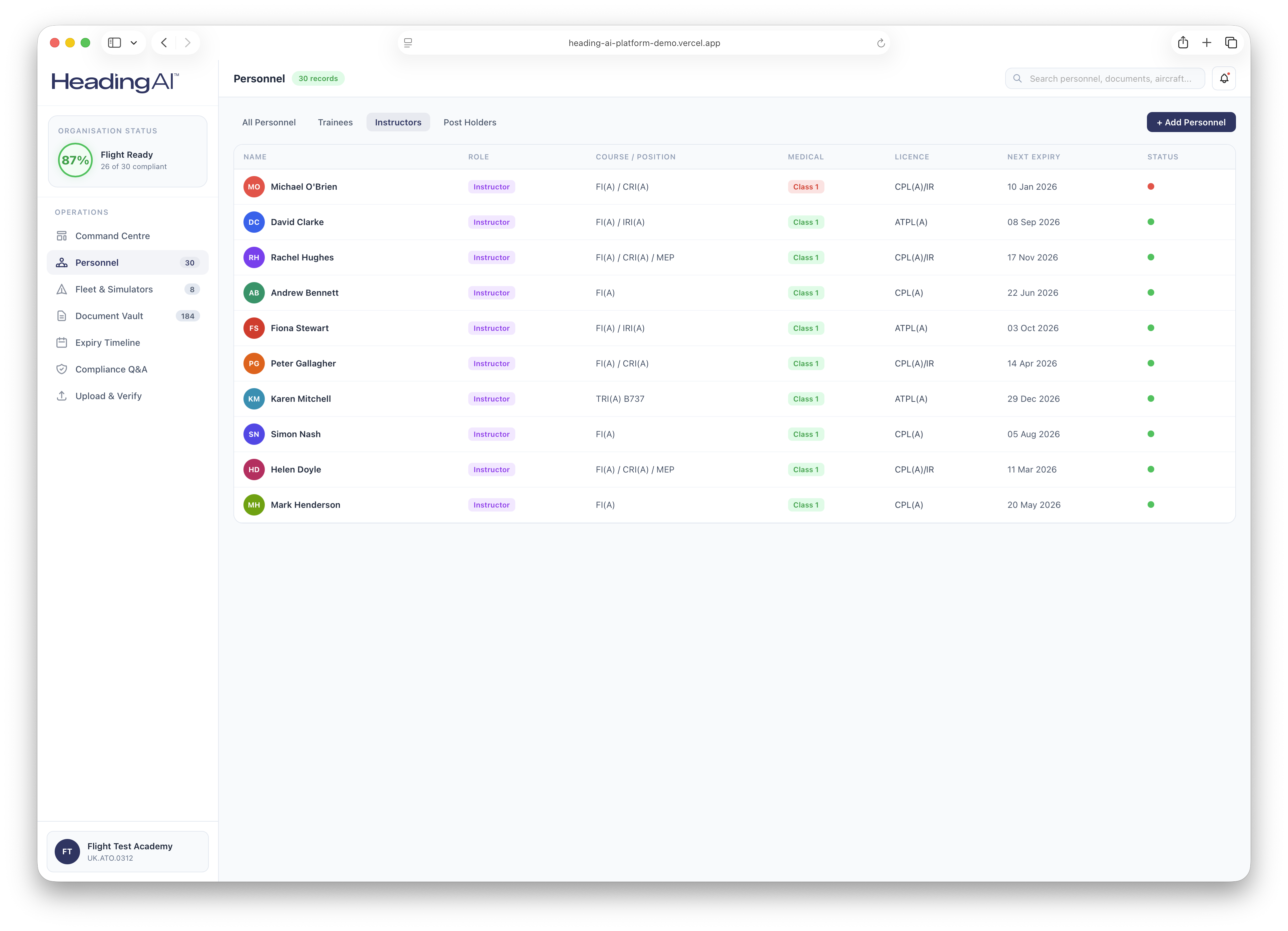
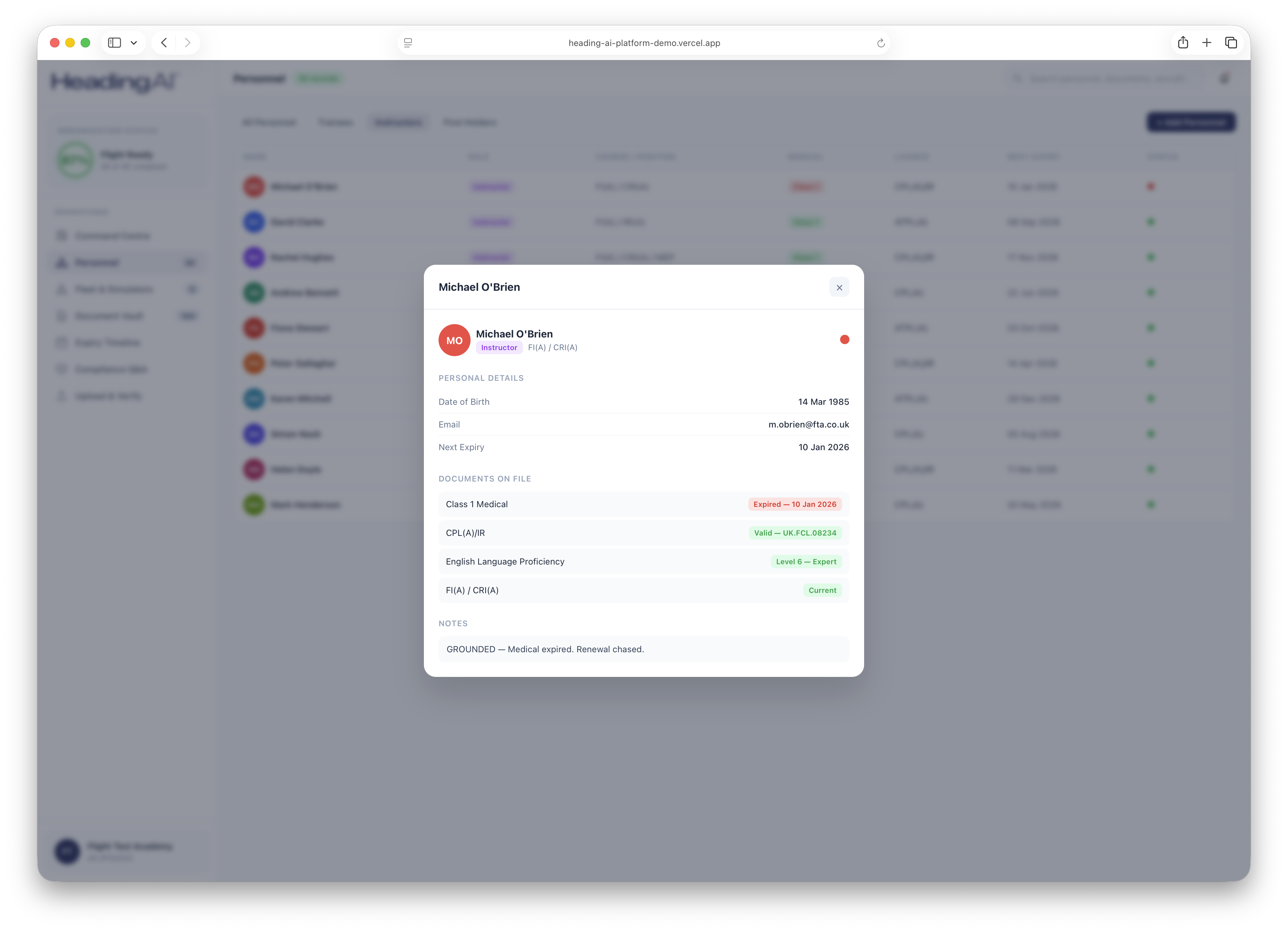
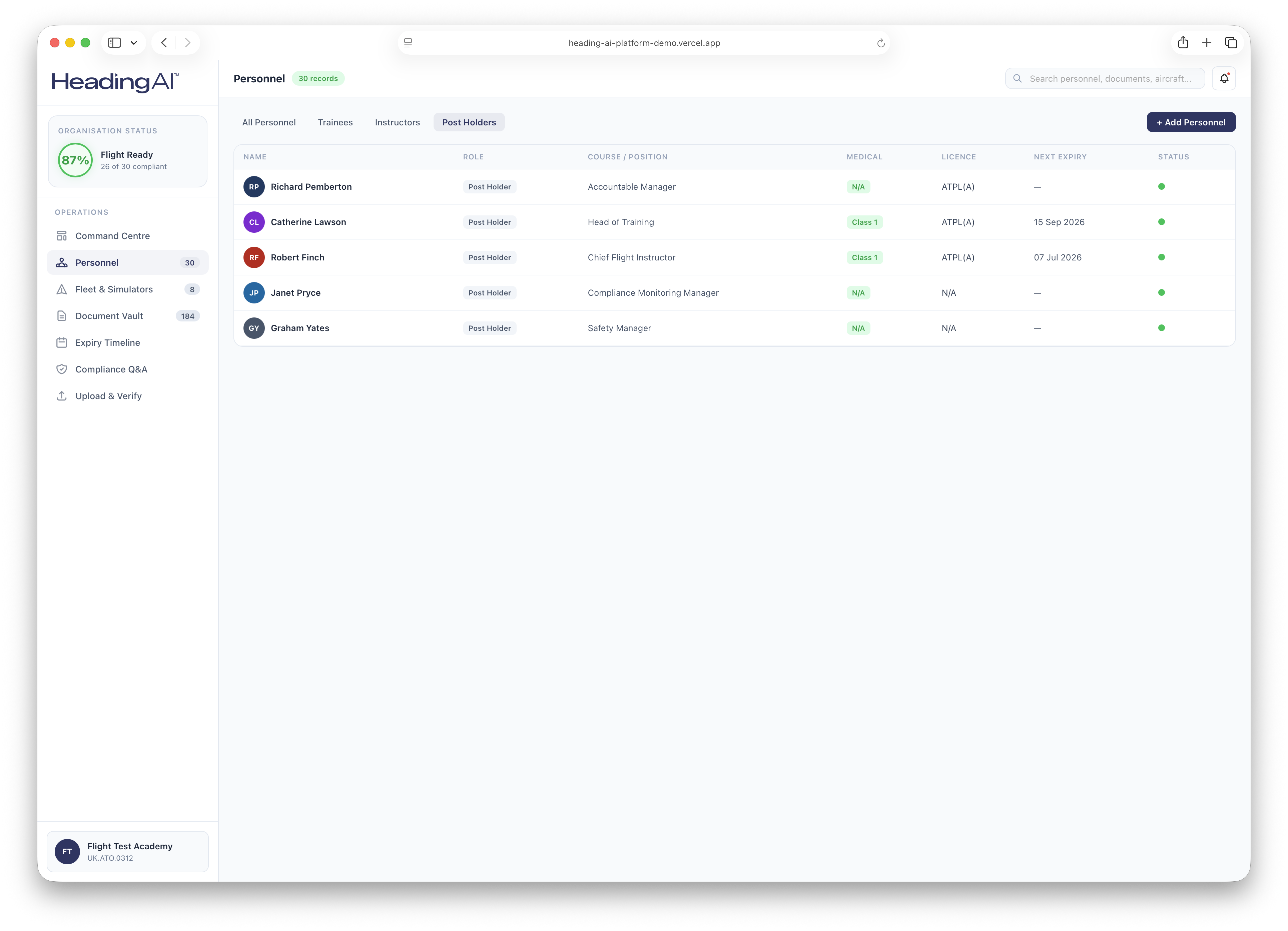
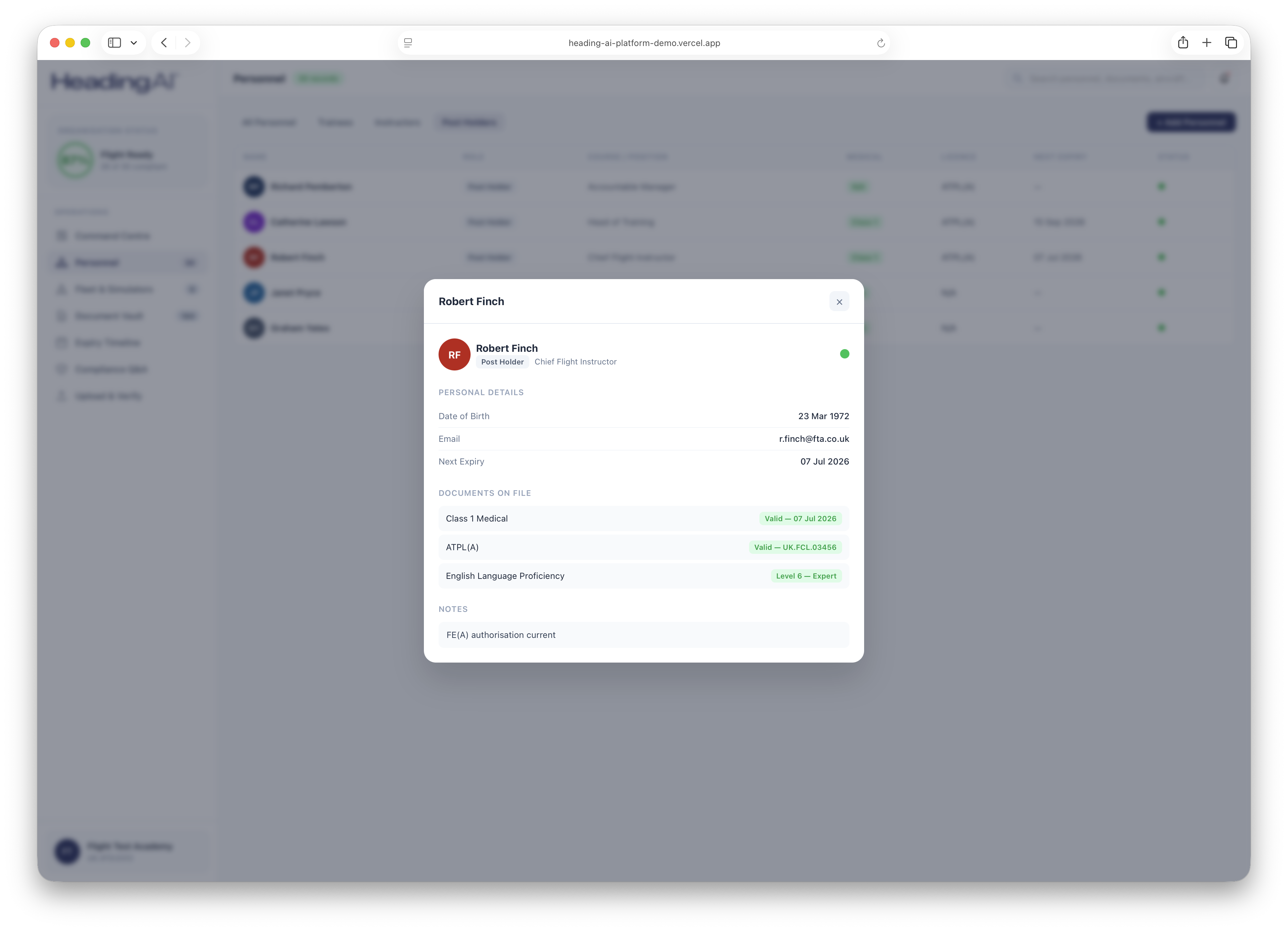
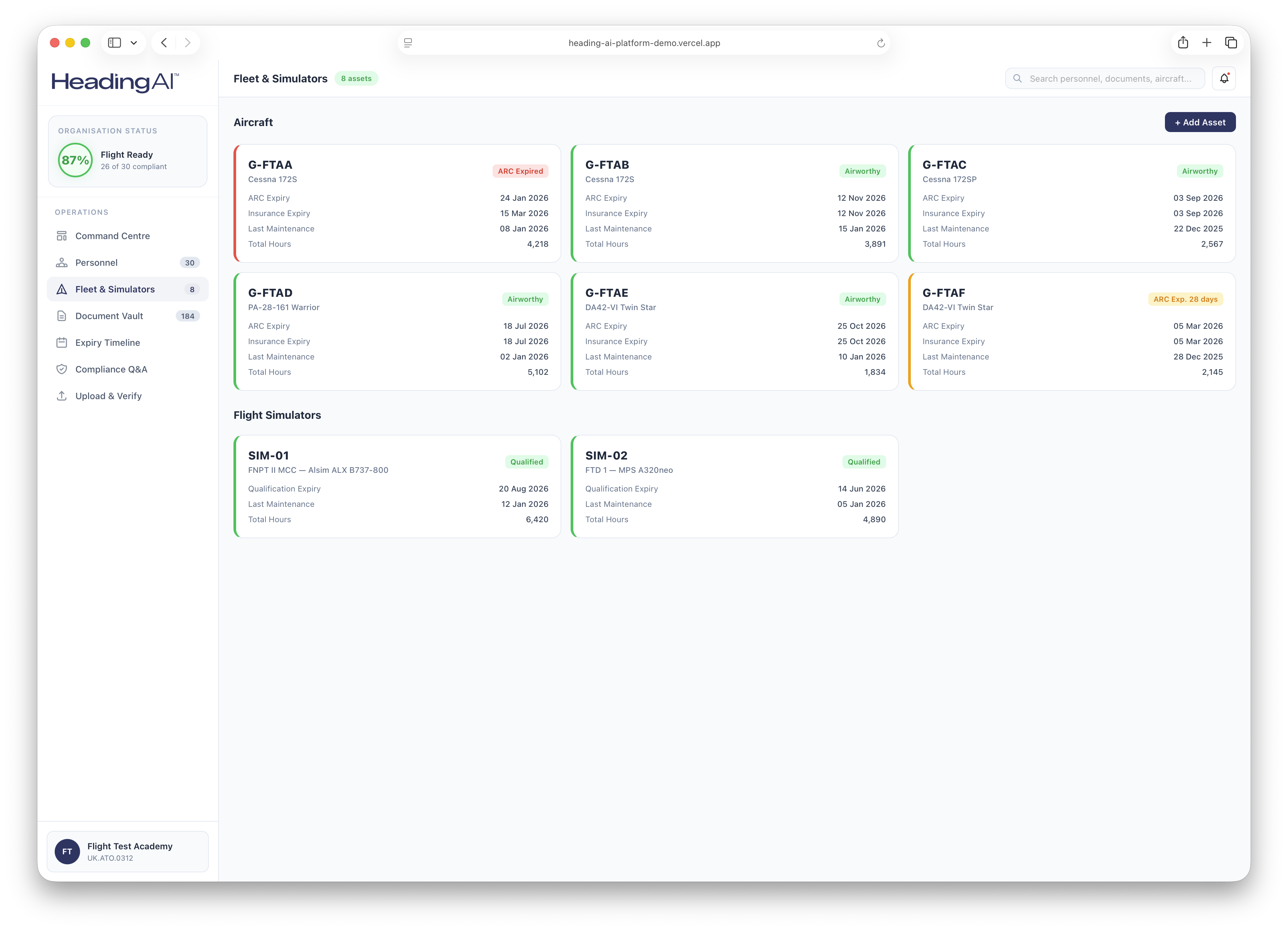
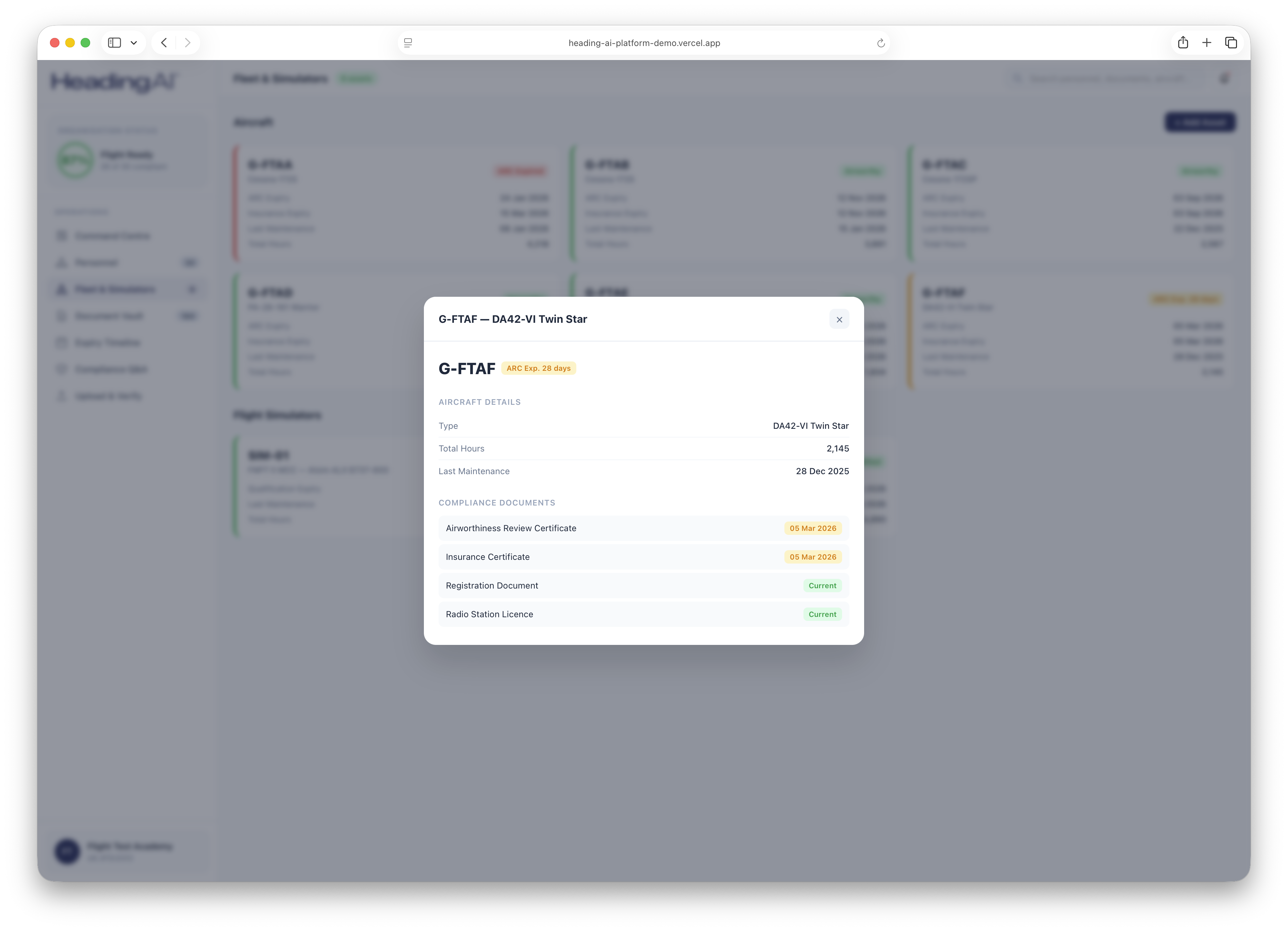
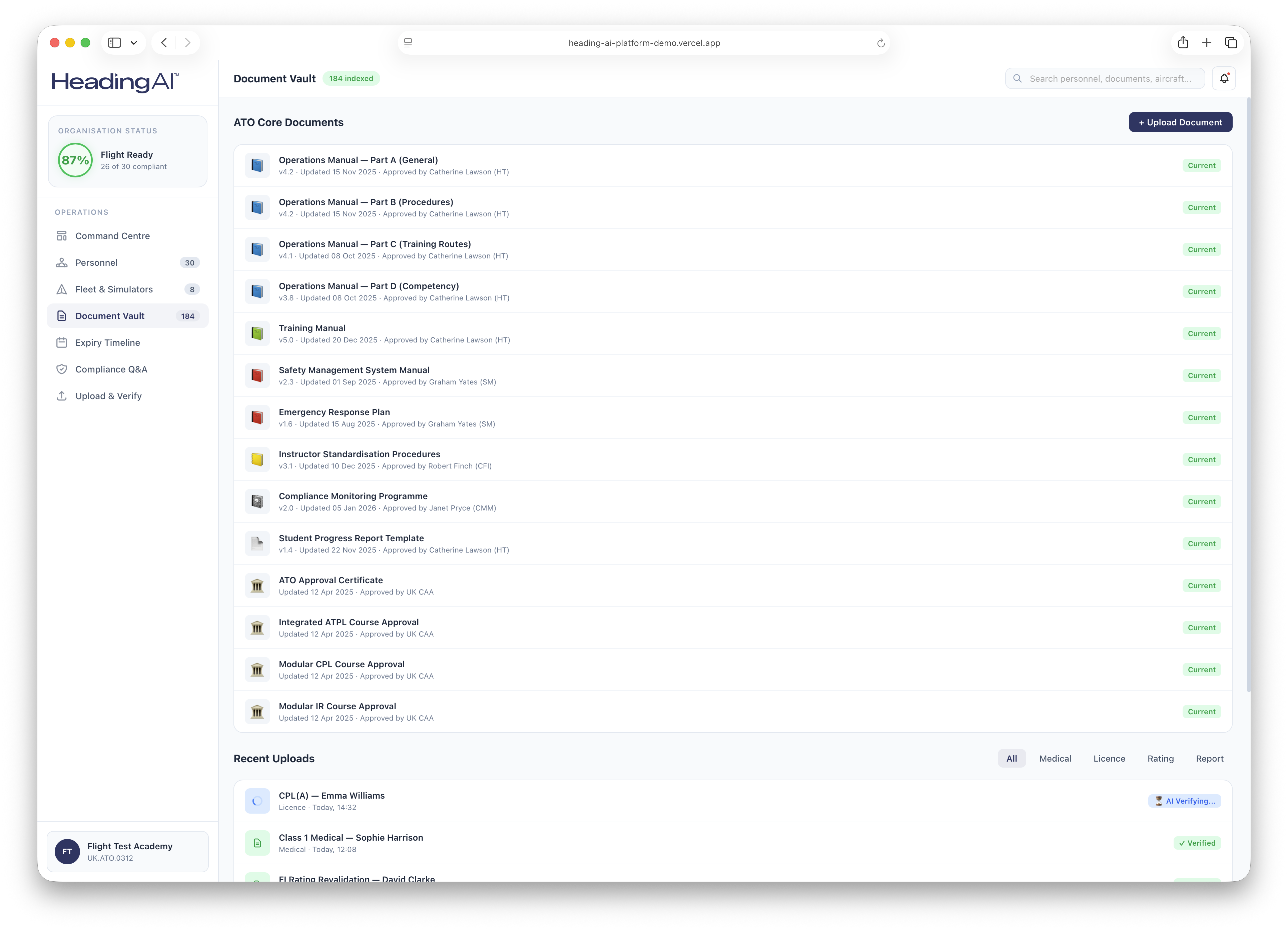
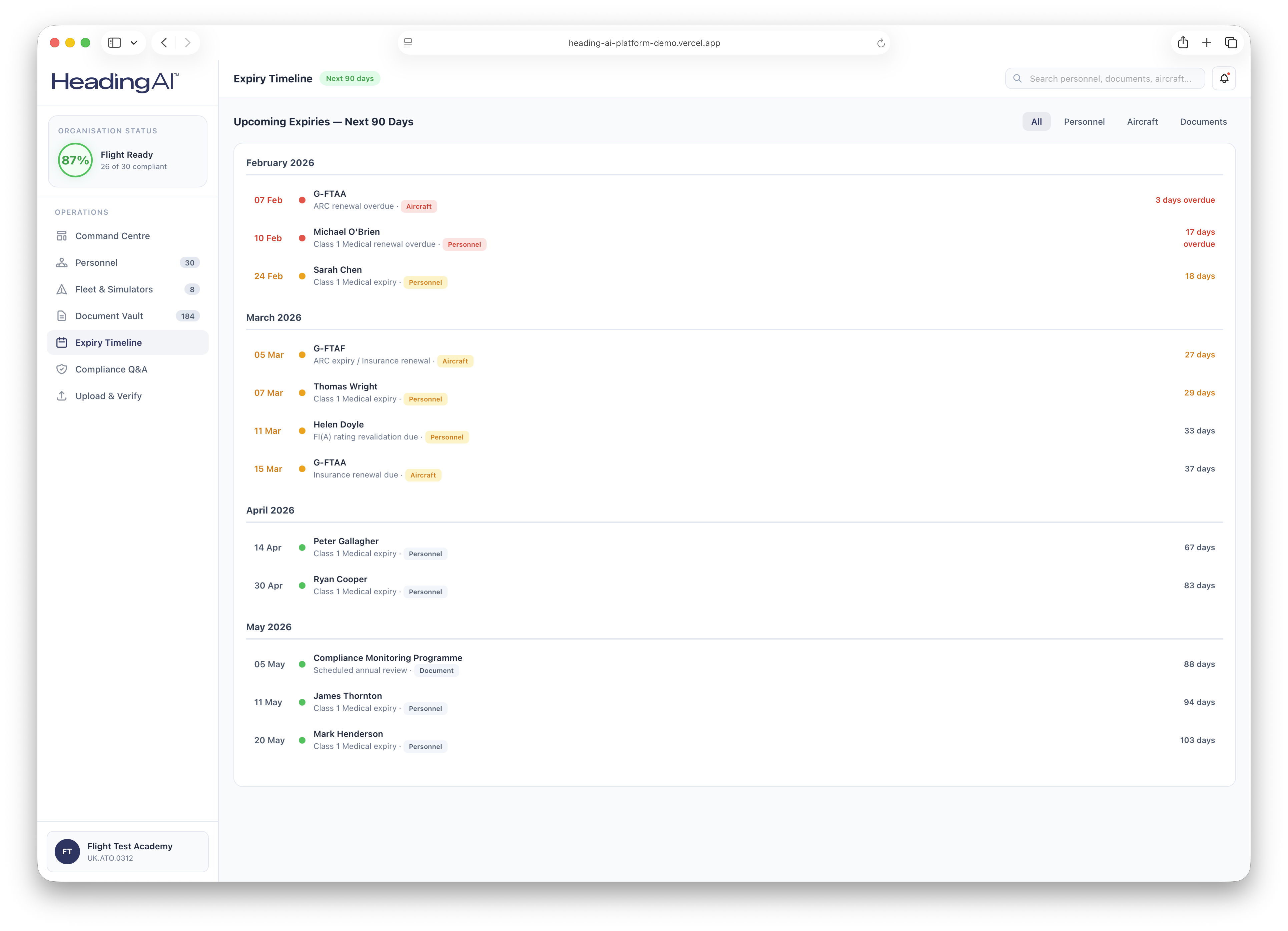
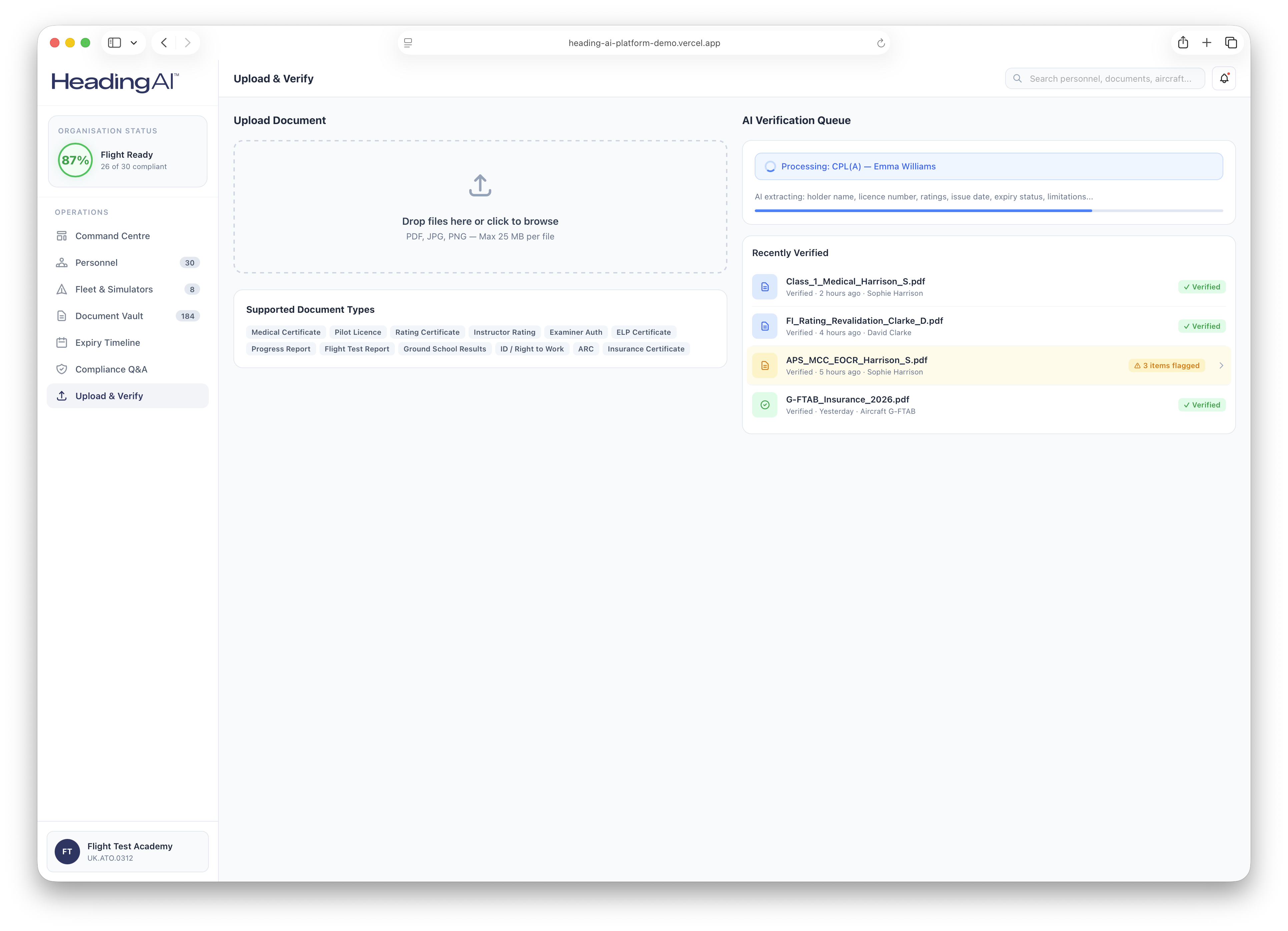
Upload any aviation document – medical certificates, licences, ratings, progress reports. AI identifies the document type automatically. AI extracts not just expiry dates but limitations, ratings, assessment outcomes, and instructor comments. Multiple pages grouped as a single record. Processes in under 20 seconds.
Cross-references extracted data against EASA and UK CAA requirements. The system applies the rules so your staff don't have to remember them. Human review before anything is committed to the record. Traffic light status shows compliance at a glance.
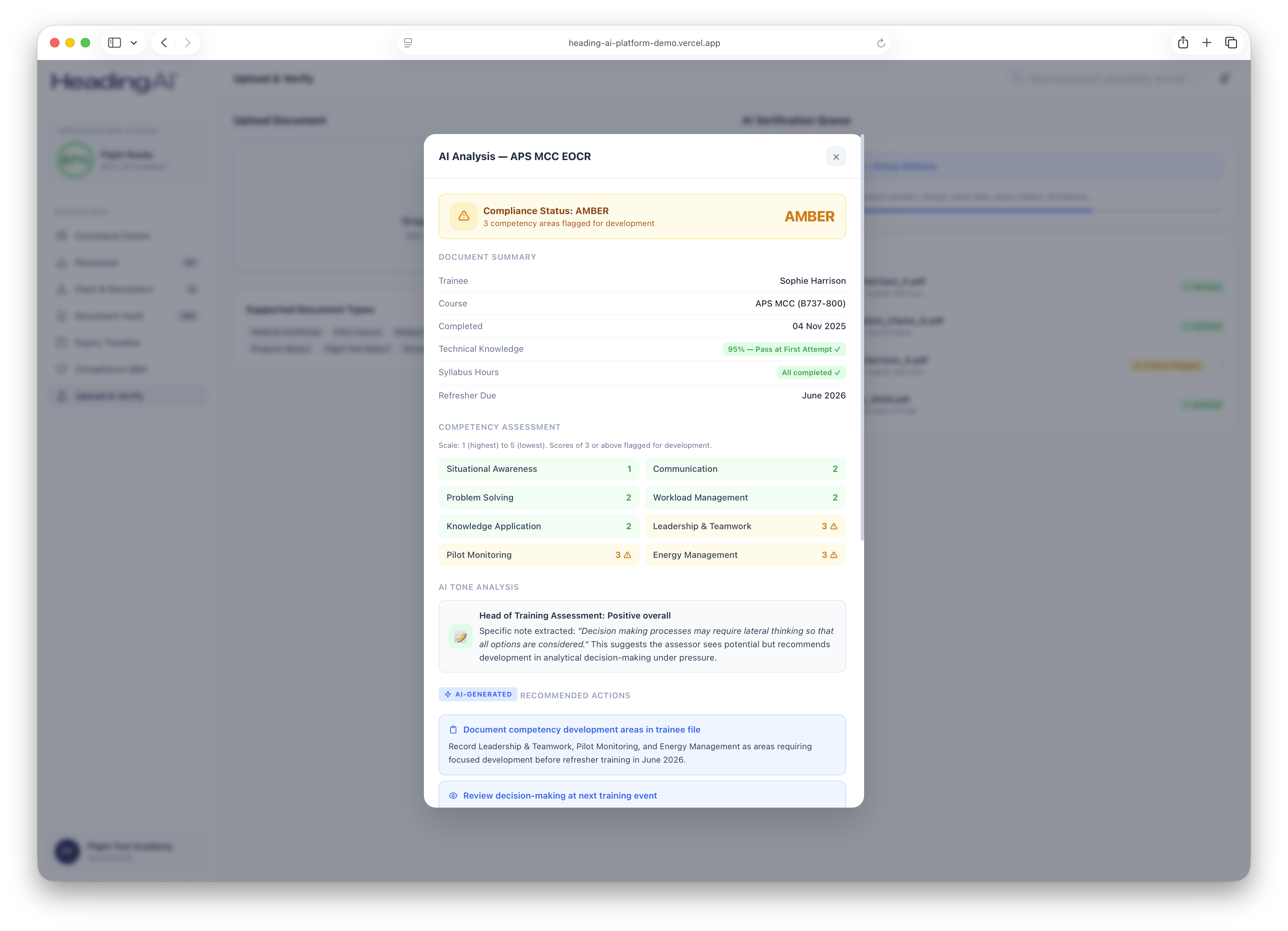
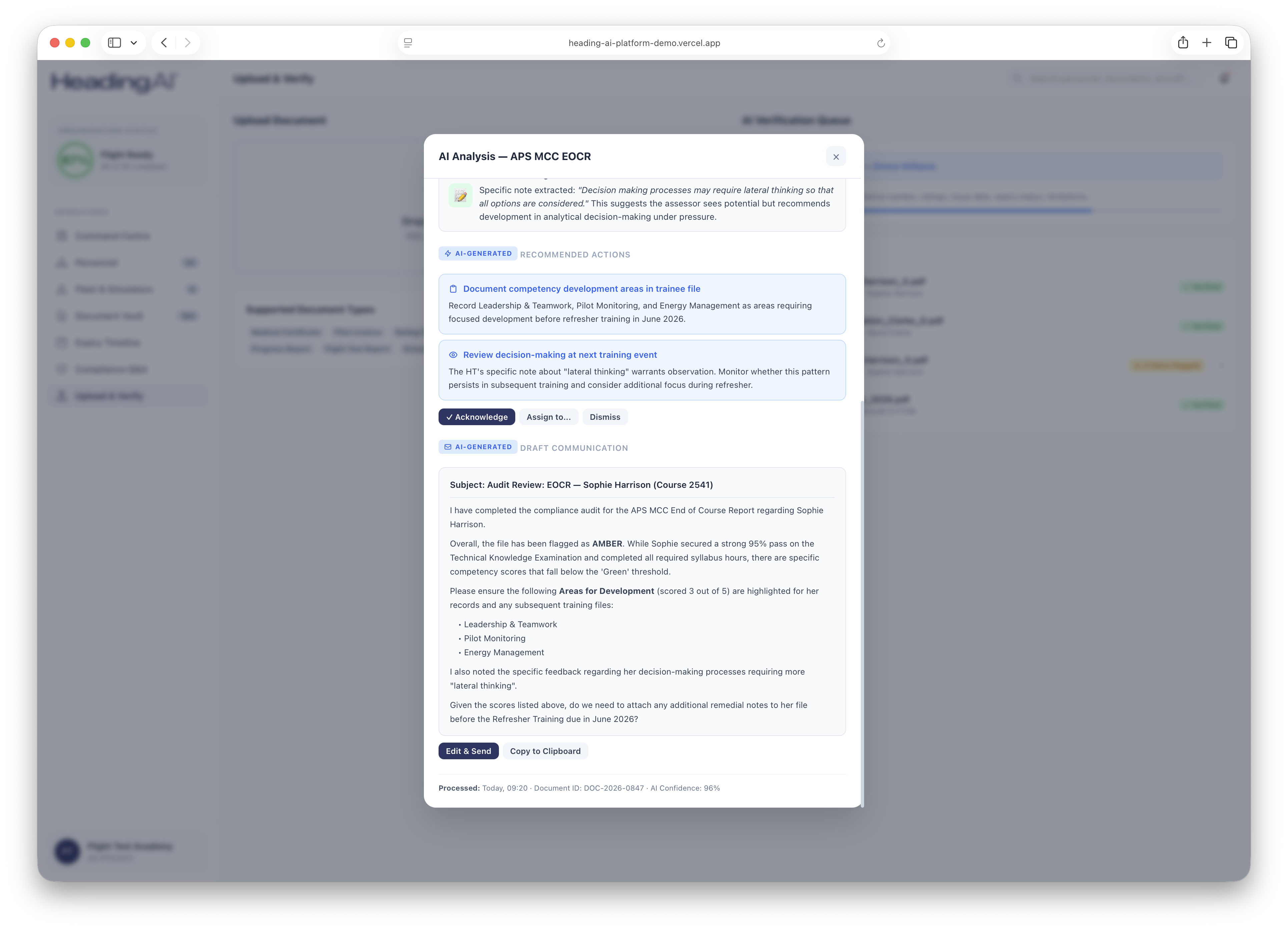
AI analyses uploaded documents and surfaces insights automatically. Trainee performance trajectories, instructor standardisation patterns, competency development areas, recommended actions. Prevents problems before they occur.
CAA and EASA publish amendments, safety bulletins, and information notices continuously. Heading AI delivers a plain-English weekly digest to your post-holders, flagging developments relevant to your approved courses and procedures.
When an instructor uploads a trainee's End of Course Report, Heading AI doesn't just file it. The system reads, analyses, and surfaces insights that would otherwise require expert human review.
Sophie Harrison – Uploaded 5 hours ago
Heading AI doesn't just track documents. It builds a continuously deepening picture of your training operation. These are the questions the platform is designed to answer.
Heading AI analyses every progress report, assessment, and instructor comment to build a performance trajectory for each trainee, flagging declining patterns before they become test failures.
Graduate profiles with competency scores, training history, and instructor assessments are compiled automatically, ready to share when airline partners ask for recommendations.
Instructor standardisation analytics surface competency variance across your team, informing where standardisation conversations or additional training may be warranted.
The intelligence compounds over time. The more documents processed throughout the training lifecycle, the richer and more valuable the analysis becomes.
Staff or trainees upload documents. Medical certificates, licences, ratings, progress reports – any compliance-relevant document.
AI reads each document, extracts key data, and cross-references against regulatory requirements. Processing completes in under 20 seconds.
Real-time status updates, proactive alerts, recommended actions. Compliance intelligence that prevents problems before they occur.
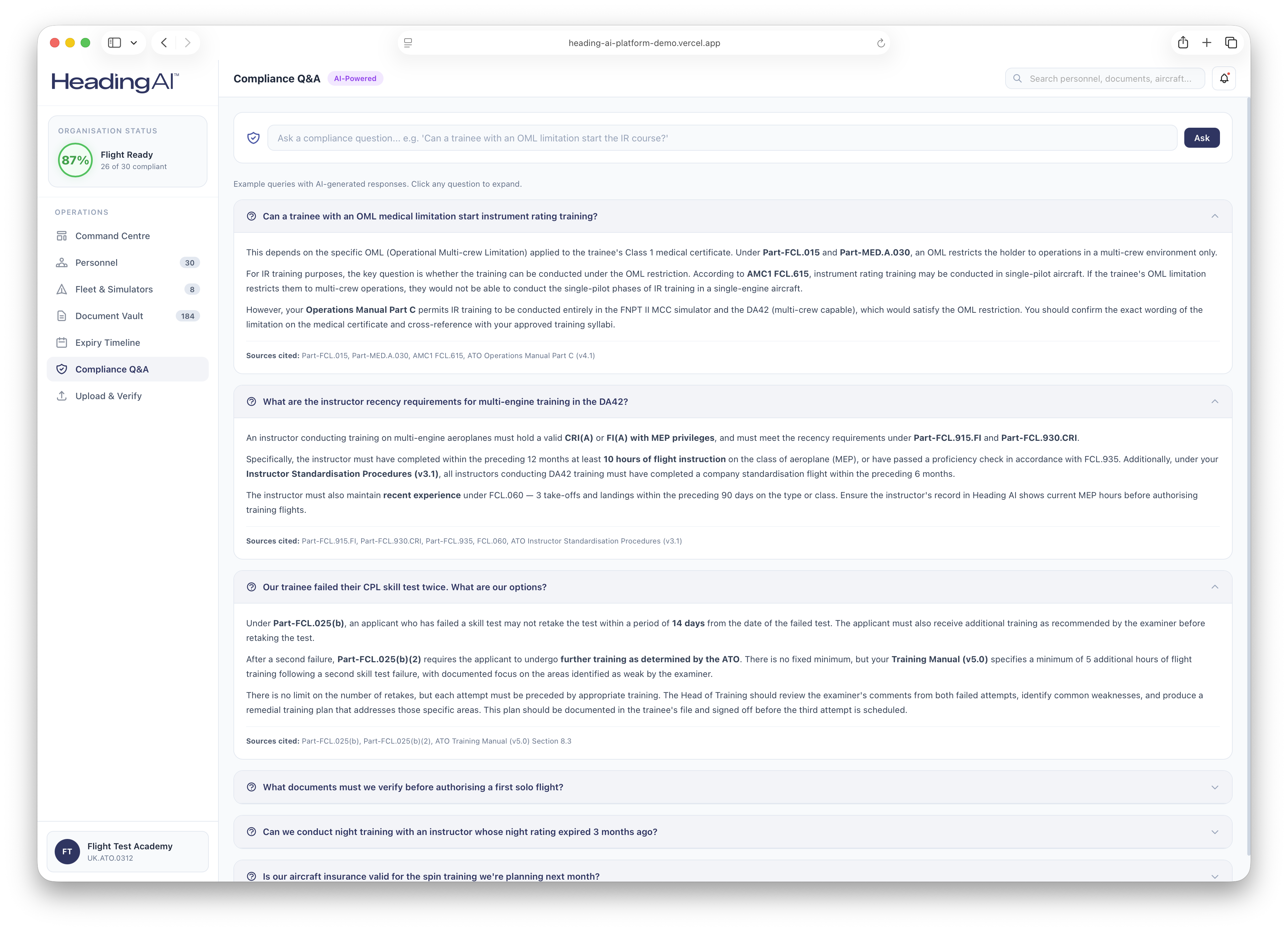
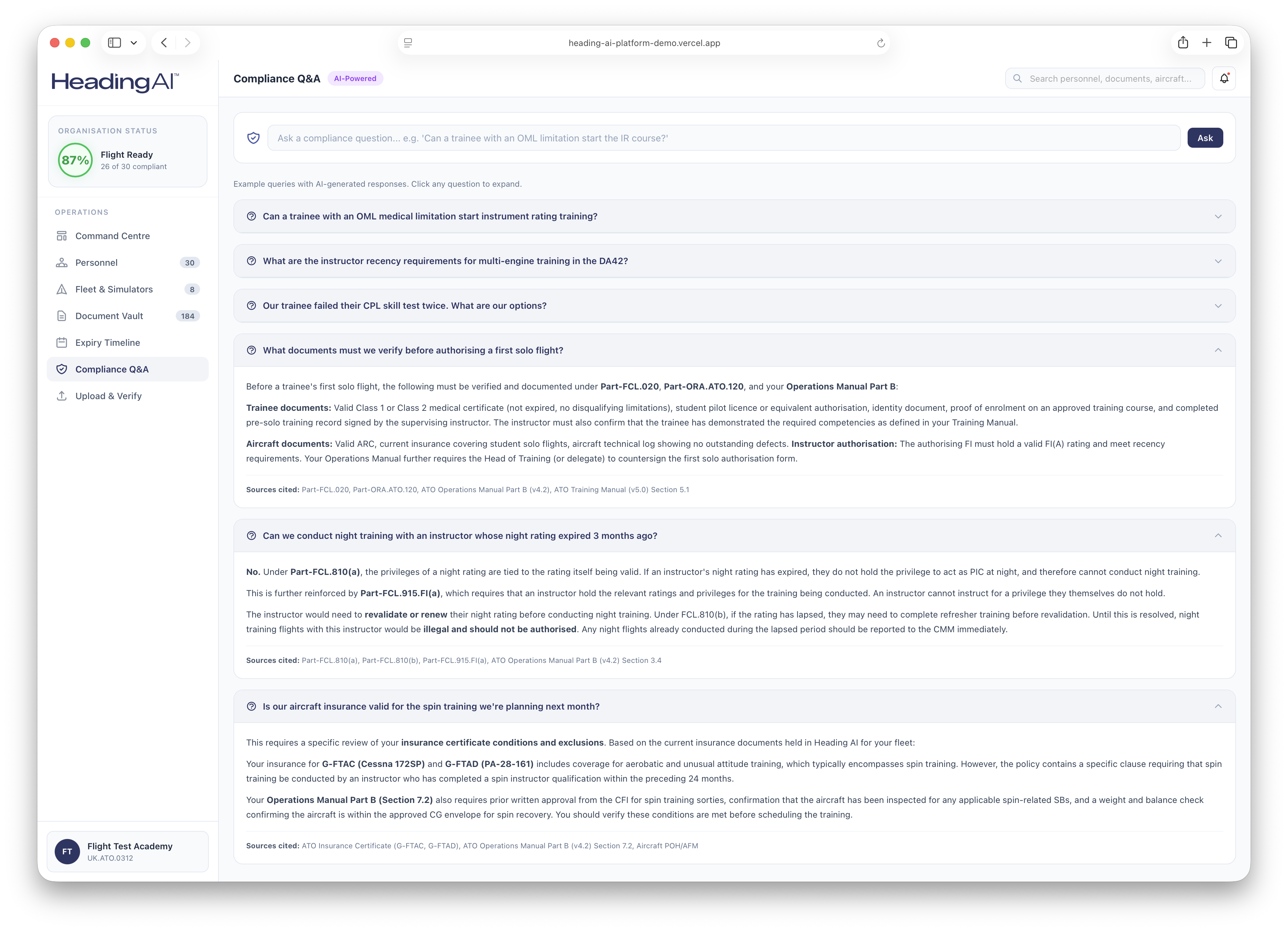
Heading AI's knowledge base combines regulatory knowledge, your own manuals and procedures, and live operational data. No more hunting through documents. Ask the question, get the answer, see the sources cited.
This depends on the specific OML (Operational Multi-crew Limitation) applied to the trainee's Class 1 medical certificate. Under Part-FCL.015 and Part-MED.A.030, an OML restricts the holder to operations in a multi-crew environment only.
For IR training purposes, the key question is whether the training can be conducted under the OML restriction. According to AMC1 FCL.615, instrument rating training may be conducted in single-pilot aircraft. If the trainee's OML limitation restricts them to multi-crew operations, they would not be able to conduct the single-pilot phases of IR training in a single-engine aircraft.
However, your Operations Manual Part C permits IR training to be conducted entirely in the FNPT II MCC simulator and the DA42 (multi-crew capable), which would satisfy the OML restriction. You should confirm the exact wording of the limitation on the medical certificate and cross-reference with your approved training syllabi.
An instructor conducting training on multi-engine aeroplanes must hold a valid CRI(A) or FI(A) with MEP privileges, and must meet the recency requirements under Part-FCL.915.FI and Part-FCL.930.CRI.
Specifically, the instructor must have completed within the preceding 12 months at least 10 hours of flight instruction on the class of aeroplane (MEP), or have passed a proficiency check in accordance with FCL.935. Additionally, under your Instructor Standardisation Procedures (v3.1), all instructors conducting DA42 training must have completed a company standardisation flight within the preceding 6 months.
The instructor must also maintain recent experience under FCL.060 — 3 take-offs and landings within the preceding 90 days on the type or class. Ensure the instructor's record in Heading AI shows current MEP hours before authorising training flights.
Under Part-FCL.025(b), an applicant who has failed a skill test may not retake the test within a period of 14 days from the date of the failed test. The applicant must also receive additional training as recommended by the examiner before retaking the test.
After a second failure, Part-FCL.025(b)(2) requires the applicant to undergo further training as determined by the ATO. There is no fixed minimum, but your Training Manual (v5.0) specifies a minimum of 5 additional hours of flight training following a second skill test failure, with documented focus on the areas identified as weak by the examiner.
There is no limit on the number of retakes, but each attempt must be preceded by appropriate training. The Head of Training should review the examiner's comments from both failed attempts, identify common weaknesses, and produce a remedial training plan that addresses those specific areas. This plan should be documented in the trainee's file and signed off before the third attempt is scheduled.
Before a trainee's first solo flight, the following must be verified and documented under Part-FCL.020, Part-ORA.ATO.120, and your Operations Manual Part B:
Trainee documents: Valid Class 1 or Class 2 medical certificate (not expired, no disqualifying limitations), student pilot licence or equivalent authorisation, identity document, proof of enrolment on an approved training course, and completed pre-solo training record signed by the supervising instructor. The instructor must also confirm that the trainee has demonstrated the required competencies as defined in your Training Manual.
Aircraft documents: Valid ARC, current insurance covering student solo flights, aircraft technical log showing no outstanding defects. Instructor authorisation: The authorising FI must hold a valid FI(A) rating and meet recency requirements. Your Operations Manual further requires the Head of Training (or delegate) to countersign the first solo authorisation form.
No. Under Part-FCL.810(a), the privileges of a night rating are tied to the rating itself being valid. If an instructor's night rating has expired, they do not hold the privilege to act as PIC at night, and therefore cannot conduct night training.
This is further reinforced by Part-FCL.915.FI(a), which requires that an instructor hold the relevant ratings and privileges for the training being conducted. An instructor cannot instruct for a privilege they themselves do not hold.
The instructor would need to revalidate or renew their night rating before conducting night training. Under FCL.810(b), if the rating has lapsed, they may need to complete refresher training before revalidation. Until this is resolved, night training flights with this instructor would be illegal and should not be authorised. Any night flights already conducted during the lapsed period should be reported to the CMM immediately.
This requires a specific review of your insurance certificate conditions and exclusions. Based on the current insurance documents held in Heading AI for your fleet:
Your insurance for G-FTAC (Cessna 172SP) and G-FTAD (PA-28-161) includes coverage for aerobatic and unusual attitude training, which typically encompasses spin training. However, the policy contains a specific clause requiring that spin training be conducted by an instructor who has completed a spin instructor qualification within the preceding 24 months.
Your Operations Manual Part B (Section 7.2) also requires prior written approval from the CFI for spin training sorties, confirmation that the aircraft has been inspected for any applicable spin-related SBs, and a weight and balance check confirming the aircraft is within the approved CG envelope for spin recovery. You should verify these conditions are met before scheduling the training.
We're collaborating with a small group of UK CAA and EASA approved training organisations to shape Heading AI. Private beta launches Q2 2026.
Whether you have questions about Heading AI, want to discuss how it could work for your ATO, or are interested in the private beta, we'd welcome the conversation.